Are Temporary Emails Legal?
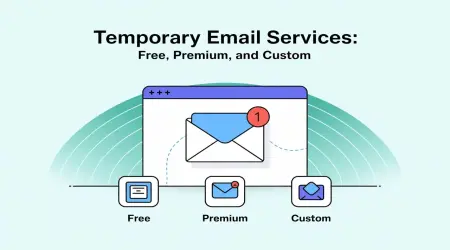
Temporary email services
Temporary email services have become a normal part of internet culture. Millions of people use them every day to sign up for websites, receive verification codes, access free trials, download resources, and avoid filling their personal inboxes with unwanted messages. For many users, a temporary email address is simply another online tool, no different from a password manager or an ad blocker.
Yet despite their growing popularity, one question continues to appear in forums, social media discussions, and online communities: Are temporary emails legal?
It's an understandable concern. Whenever a tool is designed to protect privacy or limit the amount of personal information shared online, some people immediately wonder whether it crosses a legal line. Others assume that because temporary emails can be used anonymously, they must exist in a legal gray area.
The reality is much less dramatic.
In most countries, using a temporary email address is completely legal. The act of creating or using a disposable email account is generally no different from creating a second email address or choosing not to share your primary inbox with every website you visit. However, as with many online tools, legality often depends less on the tool itself and more on how it is used.
Understanding that distinction is important because it helps separate common misconceptions from the actual legal and ethical considerations surrounding temporary emails.
Why Temporary Emails Exist in the First Place
To understand their legal status, it helps to look at their purpose.
The modern internet asks for email addresses constantly. Want to read a premium article? Enter your email. Interested in a free eBook? Enter your email. Need to test a new software platform? Enter your email.
Over time, this creates a situation where users are repeatedly asked to share a piece of information that has become closely tied to their digital identity. Many people eventually become uncomfortable giving their primary email address to every website they encounter.
Temporary email services emerged as a response to this reality. They allow users to receive verification messages and complete registrations without exposing their personal inbox to unnecessary communication.
At their core, temporary emails are privacy and convenience tools. They help users reduce spam, protect their primary email address, and manage short-term online interactions more efficiently.
None of these purposes are inherently illegal.
In fact, choosing how much personal information you share online is generally considered a legitimate decision for internet users.
Is Using a Temporary Email Address Against the Law?
For the vast majority of users, the answer is no.
Using a temporary email address to sign up for a website, access a free trial, test a service, or receive a verification email is generally legal. There are no laws in most jurisdictions that prohibit someone from using a disposable email account simply because it is temporary.
Think about it this way. People often maintain multiple email addresses for different purposes. One for work, one for personal communication, one for newsletters, and perhaps another for online shopping. A temporary email is simply another variation of this concept.
The law typically focuses on actions rather than tools. An email address—temporary or permanent—is merely a method of communication. What matters legally is what the user does with it.
This distinction is crucial because many online privacy tools are frequently misunderstood. Just because a tool helps protect privacy does not mean it exists outside the law.
When Temporary Emails Can Create Legal Problems
Although temporary emails themselves are generally legal, the activities performed with them may not be.
Imagine someone uses a disposable email address to commit fraud, impersonate another person, bypass legal restrictions, or violate the terms of a service in a harmful way. In that situation, the legal issue is not the temporary email itself. The problem is the fraudulent or deceptive behavior.
The same principle applies to many other technologies. A smartphone is legal. Using a smartphone to commit a crime is not. A temporary email address is legal. Using it as part of illegal activity is not.
This distinction often gets lost in online discussions.
People sometimes blame the tool when the real issue is the user's actions. From a legal standpoint, authorities generally focus on conduct rather than the simple existence of a disposable inbox.
In other words, using a temporary email for privacy is very different from using it to deceive, scam, or harm others.
Why Some Websites Block Temporary Emails
One reason people question the legality of temporary emails is that some websites actively block them.
If temporary emails are legal, why would companies refuse to accept them?
The answer has more to do with business preferences than legal concerns.
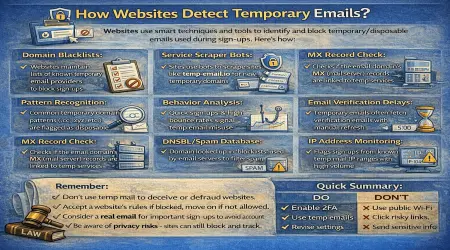
Many organizations use email addresses as a way to build long-term relationships with users. They want to send updates, provide support, recover accounts, and communicate with customers over time. Temporary emails make those goals more difficult because the inbox may disappear after a short period.
Some companies also worry about abuse. Disposable email addresses can make it easier for users to create multiple accounts, repeatedly access free trials, or bypass certain limitations.
As a result, businesses may choose to block temporary email domains. However, a company choosing not to accept a temporary email is not the same as the email being illegal.
A restaurant can require reservations. A website can require a permanent email address. Those are business policies rather than legal judgments.
The Difference Between Legal and Ethical Use
Another important distinction involves ethics.
Something can be legal while still raising ethical questions in specific situations.
For example, using a temporary email to avoid marketing messages from a website is generally considered a reasonable privacy choice. Most people would see nothing wrong with it.
On the other hand, repeatedly creating disposable accounts to exploit promotional offers that were intended for new users only may raise ethical concerns, even if it doesn't immediately violate a law.
The internet is full of situations where legality and ethics overlap but are not identical.
When deciding whether to use a temporary email, it's often helpful to ask not only whether something is legal but also whether it aligns with the intended purpose of the service you're using.
Most users who employ temporary emails for privacy, spam prevention, or one-time registrations are operating well within both legal and ethical boundaries.
The Growing Importance of Privacy Tools
The question of legality has become more common because privacy itself has become a bigger topic.
People are increasingly aware of how much personal information they share online. They understand that email addresses often become connected to marketing databases, behavioral profiles, and long-term digital records.
As awareness grows, so does interest in tools that provide greater control over personal information.
Temporary emails are part of this broader trend. They allow users to participate in online services without automatically attaching every interaction to their primary inbox.
Far from being suspicious, this reflects a growing desire among internet users to make informed decisions about their digital footprint.
In many ways, temporary emails are becoming less of a niche privacy tool and more of a normal part of modern internet use.
Conclusion
So, are temporary emails legal?
In most cases, absolutely.
Using a temporary email address to protect your privacy, avoid spam, test a service, or complete a one-time registration is generally legal in most countries. The email itself is simply a tool, and like most tools, its legality depends on how it is used.
Problems arise not because the email is temporary, but because of activities that may involve fraud, deception, abuse, or other unlawful behavior. The focus of the law is typically on actions rather than the type of email address being used.
For everyday internet users, temporary emails provide a practical way to manage online registrations while maintaining greater control over personal information. They are not a loophole, a secret weapon, or a legal gray area. They are simply another option in a world where sharing an email address has become part of almost every online interaction.
As privacy concerns continue to grow, temporary emails will likely remain an important tool for users who want a cleaner inbox and a smaller digital footprint. The key is using them responsibly, ethically, and for the purposes they were designed to serve.
Have you ever used a temporary email for a website registration or free trial? Share your thoughts and experiences in the comments below.