Can You Receive Verification Codes With a Temporary Email?
If you've ever signed up for a new website, app, or online service, you've probably encountered a verification step. Before you can access the platform, you're asked to confirm your email address by entering a code or clicking a verification link sent to your inbox.
It's become such a common part of the internet that most people barely think about it anymore.
At the same time, many users are becoming more cautious about where they share their personal email addresses. Concerns about spam, data collection, marketing emails, and privacy have led to the growing popularity of temporary email addresses.
This naturally raises an important question: Can you receive verification codes with a temporary email?
The short answer is yes—in many cases, you can.
In fact, receiving verification emails is one of the primary reasons temporary email services exist. They are often designed specifically to help users complete signup processes without exposing their primary inbox.
However, the full answer is a bit more complicated. While temporary emails can receive many verification messages, they don't work with every website, and there are some important limitations to understand before relying on them.
Let's explore how verification codes work, how temporary emails handle them, and when using a temporary email makes sense.
Why Websites Use Verification Codes
Before discussing temporary emails, it's helpful to understand why verification codes exist in the first place.
Email verification serves several purposes.
First, it helps confirm that a user has access to the email address they provided during registration. Without verification, people could enter random or incorrect email addresses, creating problems for both users and platforms.
Second, verification helps reduce spam accounts and automated registrations.
Many websites use email verification as a simple security measure to ensure that new accounts are connected to real inboxes.
Third, verified email addresses provide a communication channel for account recovery, password resets, notifications, and security alerts.
A typical verification process looks something like this:
- You create an account.
- The website sends a verification email.
- You receive a code or link.
- You confirm ownership of the email address.
- Your account becomes active.
Temporary email services are often capable of handling this exact process.
How Temporary Emails Receive Verification Messages
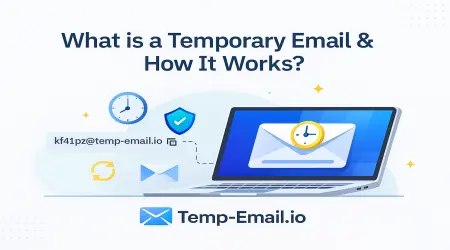
Most temporary email services function like simplified email accounts.
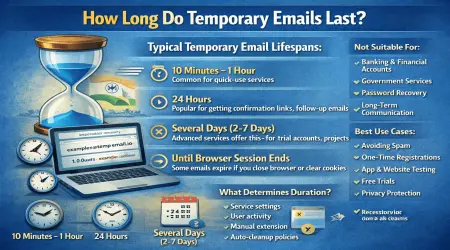
When a temporary email address is generated, it creates an inbox that can receive incoming messages for a limited period of time.
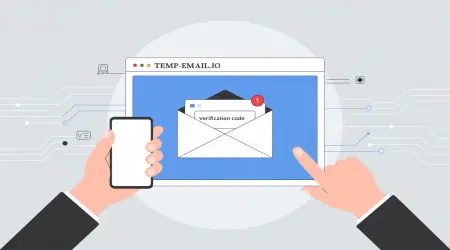
If a website sends a verification email, that message typically appears in the temporary inbox within seconds.
The user can then open the message and either:
- Copy the verification code
- Click the activation link
- Complete the signup process
This is one of the most common uses of temporary email addresses.
For example, imagine you're testing a new productivity app. The platform requires email verification before granting access to its features.
Instead of using your primary email account, you enter a temporary email address. The verification message arrives, you confirm the account, and you begin testing the service.
From the website's perspective, the verification process works normally.
From your perspective, your personal inbox remains protected.
This convenience is one reason temporary emails have become so popular among privacy-conscious users.
Why Verification Emails Sometimes Don't Arrive
Although temporary emails often work well, they are not guaranteed to receive every verification message.
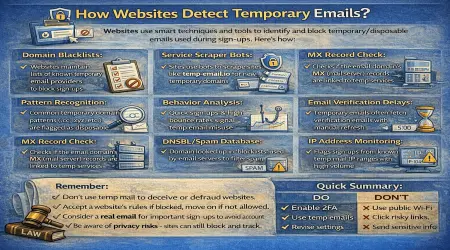
Some websites actively block temporary email providers.
Companies do this for several reasons.
Many businesses want long-term relationships with users. They rely on email for customer communication, marketing campaigns, product updates, and account recovery.
If users register with disposable addresses, maintaining those connections becomes difficult.
As a result, some platforms maintain lists of known temporary email domains and reject them during registration.
You may encounter an error message such as:
- "Please enter a valid email address."
- "Disposable email addresses are not allowed."
- "Temporary email services are not supported."
Even when a temporary email is accepted, delivery issues can occasionally occur.
Email filtering systems, anti-spam protections, and server configurations sometimes prevent messages from arriving successfully.
This doesn't mean temporary emails are unreliable, but it does mean success can vary depending on the website being used.
Verification Codes vs. Long-Term Account Access
One of the biggest misconceptions about temporary emails is that receiving a verification code is the only thing that matters.
In reality, verification is often just the beginning of a relationship with a service.
Many users create an account, verify it, and then continue using the platform for months or years.
This is where temporary emails can create challenges.
Imagine you sign up for a service using a temporary email and verify the account successfully.
Several months later:
- You forget your password.
- The platform requires identity confirmation.
- Security alerts are sent to your inbox.
- Account recovery becomes necessary.
If the temporary email address has expired, you may no longer have access to those messages.
As a result, recovering the account can become difficult or impossible.
For this reason, receiving a verification code and maintaining long-term access are two very different considerations.
Temporary emails are excellent for short-term needs but may not be ideal for accounts you plan to keep.
When Using a Temporary Email Makes Sense
Temporary emails are most useful when you're exploring or testing services without a long-term commitment.
Good examples include:
- Free trials
- Resource downloads
- Webinar registrations
- Product demonstrations
- Community exploration
- One-time website access
- Testing new apps
In these situations, the primary goal is often obtaining the verification email so you can evaluate the service.
If you later decide that the platform is valuable and worth keeping, you can often update your account with a permanent email address.
This approach allows you to enjoy the privacy benefits of temporary emails while preserving flexibility for future use.
Many experienced internet users adopt this strategy when evaluating unfamiliar services.
The Privacy Benefits of Verification Through Temporary Emails
Receiving verification codes through a temporary email offers more than convenience.
It can also improve privacy.
Every time you share your primary email address, it becomes part of another database. If that database is later compromised, your information could be exposed.
Temporary emails help reduce this exposure.
Instead of connecting your primary inbox to every service you test, you reserve it for accounts that genuinely matter.
This separation provides several advantages:
- Reduced spam
- Fewer marketing emails
- Lower data breach exposure
- Better inbox organization
- Improved control over personal information
In many ways, temporary emails act as a screening tool.
They allow you to evaluate whether a service deserves access to your permanent contact information.
This can be especially valuable in an online world where new apps, tools, and websites appear every day.
So, can you receive verification codes with a temporary email?
In most cases, yes.
Receiving verification emails is one of the main functions of temporary email services. They allow users to complete account registrations, access online resources, and test new services without immediately sharing their primary email address.
However, there are limitations. Some websites block temporary email providers, and using a disposable address may create challenges if you need long-term account access later.
The key is understanding when temporary emails are appropriate.
For short-term registrations, free trials, and service testing, they can be incredibly useful. For important accounts that require ongoing access and account recovery options, a permanent email address is usually the safer choice.
Ultimately, temporary emails provide a practical balance between convenience and privacy. They allow users to receive verification codes while maintaining greater control over their digital footprint.
Have you ever used a temporary email to receive a verification code? Share your experience in the comments and let us know whether it helped simplify your online registrations.