Common Security Myths About Temporary Emails
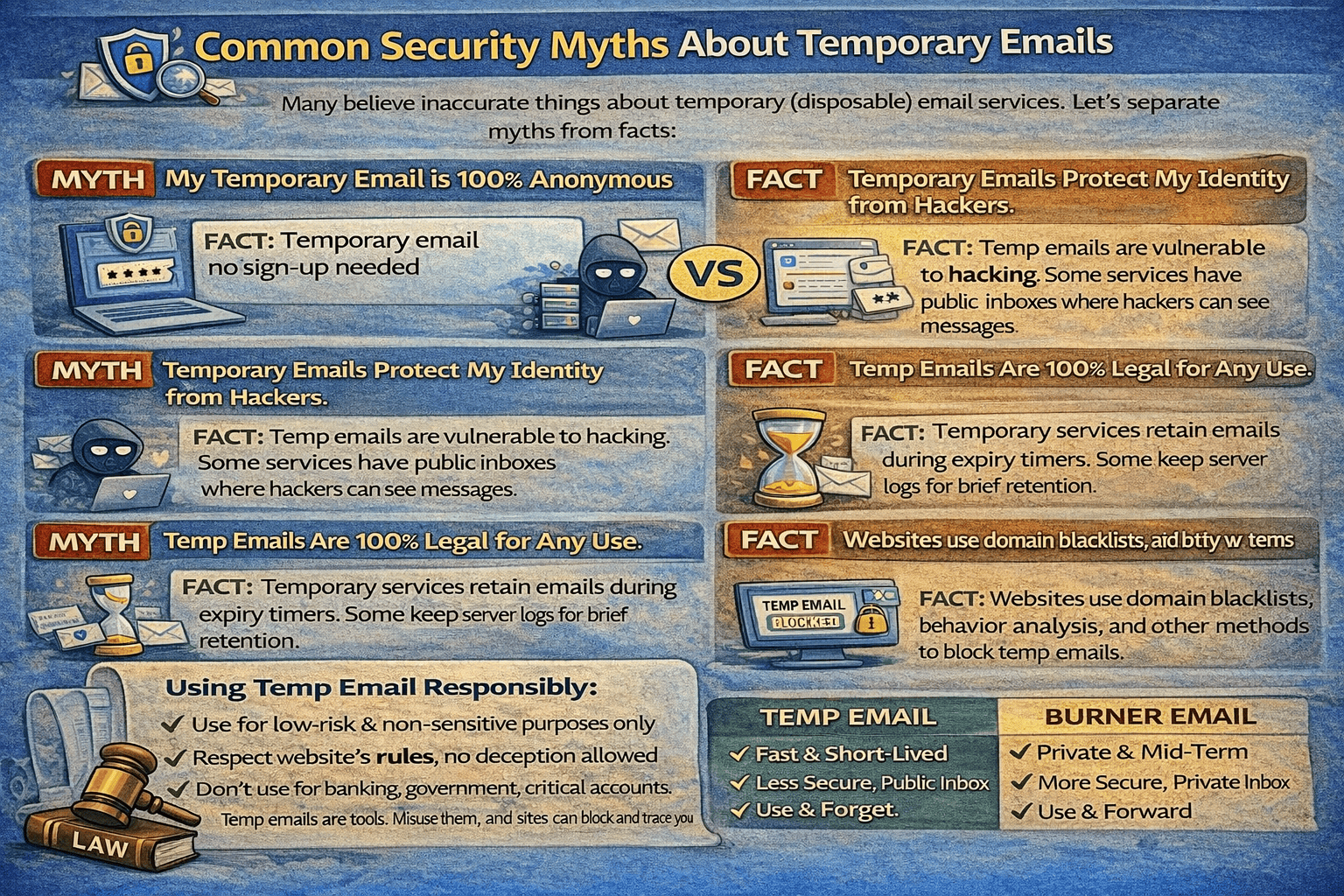
Temporary email services are widely used to protect privacy, reduce spam, and simplify online signups. However, there are still many security myths surrounding temporary emails that confuse users and sometimes stop them from using these tools correctly.
In this article, we’ll break down the most common security myths about temporary emails, explain what’s true and what’s not, and show how services like temp-email.io can be used safely and responsibly.
What Is a Temporary Email Address?
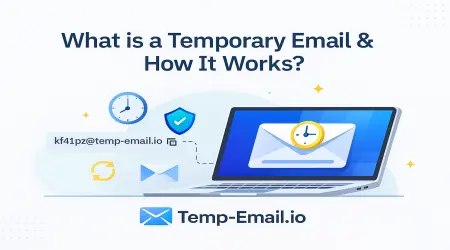
A temporary email address (also called disposable email or temp mail) is a short-term inbox that lets you receive emails without using your personal email address. These inboxes automatically expire and delete messages after a set time.
If you’re new to this concept, start here:
👉 What Is a Temporary Email Address? (Beginner Guide)
(internal link suggestion: /what-is-temporary-email)
Myth #1: Temporary Emails Are Illegal
❌ Myth
Many people believe using temporary email is illegal or against the law.
✅ Reality
Temporary email is legal in India and worldwide. There are no laws that ban disposable email services. Like any tool, legality depends on how it’s used, not the tool itself.
Using temp email to:
Avoid spam
Protect privacy
Sign up for websites
Test services
is completely legal.
👉 Learn more:
Is Temporary Email Legal in India and Worldwide?
(internal link suggestion: /is-temporary-email-legal)
Myth #2: Temporary Emails Are Unsafe by Default
❌ Myth
Some users assume temporary email services are insecure or dangerous.
✅ Reality
Temporary emails are generally safe when used for the right purposes. They don’t store personal data, passwords, or long-term inbox history.
In fact, they often reduce risk by:
Hiding your real email
Limiting spam exposure
Reducing phishing attempts
👉 Learn more:
Is Temporary Email Safe to Use?
(internal link suggestion: /temporary-email-safety)
Myth #3: Temporary Emails Can Be Easily Hacked
❌ Myth
People often think hackers target temporary email services.
✅ Reality
Temporary email services are low-value hacking targets because:
No user accounts exist
No passwords are stored
Emails auto-delete
No long-term data is retained
There is very little incentive for attackers.
👉 Learn more:
Can Temporary Emails Be Tracked or Hacked?
(internal link suggestion: /temporary-email-tracked-hacked)
Myth #4: Temporary Emails Provide Complete Anonymity
❌ Myth
Some users believe temporary email makes them 100% anonymous online.
✅ Reality
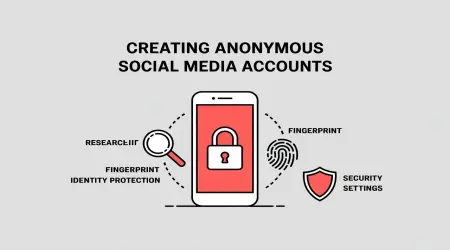
Temporary email improves privacy—but it does not make you invisible.
It protects against:
Email-based tracking
Spam lists
Long-term profiling
It does not protect against:
IP address tracking
Cookies
Browser fingerprinting
Temporary email should be part of a broader privacy strategy.
👉 Learn more:
How Temporary Email Protects Your Online Privacy
(internal link suggestion: /temporary-email-online-privacy)
Myth #5: Temporary Emails Are Only Used for Bad Purposes
❌ Myth
Some believe temp emails are mainly used for fraud or abuse.
✅ Reality
The majority of users use temporary email for legitimate reasons, such as:
Avoiding spam
Protecting inbox privacy
Testing apps and websites
Free trials and downloads
One-time registrations
👉 Read more:
Temporary Email Use Cases Explained
(internal link suggestion: /temporary-email-use-cases)
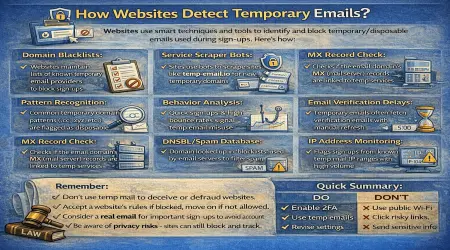
Myth #6: Temporary Emails Always Get Blocked
❌ Myth
Users think all websites block disposable email addresses.
✅ Reality
Not all websites block temporary emails. Many:
Allow them completely
Only block known domains
Allow them for low-risk actions
Blocking is a website policy decision, not a technical rule.
👉 Learn more:
How Websites Detect Temporary Emails
(internal link suggestion: /how-websites-detect-temp-email)
Myth #7: Temporary Emails Are Better Than Personal Email for Everything
❌ Myth
Some users try to use temporary email for all accounts.
✅ Reality
Temporary email is not a replacement for personal email.
Do not use temp email for:
Banking
Financial services
Government portals
Important long-term accounts
The best approach is to use both, depending on the situation.
👉 Compare clearly:
Temporary Email vs Personal Email: Key Differences
(internal link suggestion: /temporary-email-vs-personal-email)
Myth #8: Temporary Emails Store Your Data Permanently
❌ Myth
Some users worry their emails are stored forever.
✅ Reality
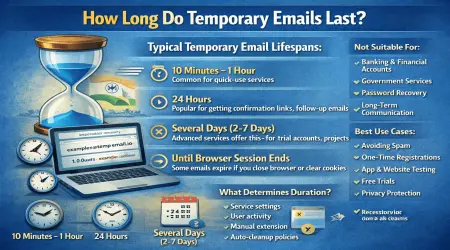
Temporary email services are designed for short-term storage only. Emails are automatically deleted after a set time.
This actually improves privacy and reduces long-term risk.
👉 Learn more:
How Long Do Temporary Emails Last?
(internal link suggestion: /temporary-email-lifetime)
Myth #9: Temporary Emails Increase Phishing Risk
❌ Myth
People think temp email exposes them to more scams.
✅ Reality
Temporary email often reduces phishing risk by keeping your real inbox away from unknown sites.
Phishing attempts end up in a disposable inbox that expires.
👉 Learn more:
Phishing Risks and How Temporary Email Helps
(internal link suggestion: /phishing-risks-temp-email)
Why temp-email.io Is Designed for Safe Use
temp-email.io focuses on:
No user registration
No password storage
Automatic email deletion
Minimal data retention
Privacy-first design
It’s built for responsible, everyday privacy protection.
👉 Try it instantly:
Free Temporary Email Inbox
(internal link suggestion: /)
Final Thoughts
Most security concerns around temporary email come from misunderstanding, not real risk.
When used correctly:
Temporary email is legal
Temporary email is safe
Temporary email protects privacy
Temporary email reduces spam and phishing
The key is knowing when and how to use it.
If you want a simple, privacy-friendly way to protect your inbox and reduce online risk, temp-email.io is a reliable solution.