Do Temporary Emails Work for Mobile App Signups?
Mobile App Signups?
If you've ever downloaded a mobile app, you know the routine.
You open the app, explore a bit, and then suddenly a screen appears asking you to sign up. Some apps let you continue as a guest, but many don’t. Instead, they want an email address before you can even see what the app really offers.
At that moment, you might pause and think: Do I really want to use my personal email for this?
This is where temporary email addresses often come into the conversation.
They seem like a simple solution—just generate a quick email, sign up, and avoid sharing your real inbox. No spam. No long-term commitment. No clutter.
But the real question is more important than convenience: Do temporary emails actually work for mobile app signups, and are they reliable?
The answer is: sometimes yes, sometimes no—and it depends heavily on the app.
Let’s break it down in a practical, real-world way so you know exactly when temporary emails help and when they might cause problems.
Why Mobile Apps Ask for Your Email in the First Place
Before we talk about temporary emails, it helps to understand why apps want your email address so early in the process.
From a business perspective, email addresses are incredibly valuable. They are not just for login purposes. They are part of how companies build user accounts, recover passwords, send updates, track engagement, and sometimes even personalize marketing.
For users, the email is often the “key” to their account. If you lose your password or switch devices, the email is usually the recovery method.
So when an app asks for your email, it’s usually for one of these reasons:
- Creating a user account
- Syncing data across devices
- Sending verification codes
- Enabling password recovery
- Sending updates or promotions
- Tracking user activity for analytics
Not all apps use email the same way, but almost all treat it as a core part of identity.
This is where privacy concerns begin for many users. Because once your email is linked to an app, it often becomes part of a long-term digital record.
Where Temporary Emails Work Well for Mobile Apps
Temporary emails can work surprisingly well in certain app scenarios.
Think of situations where the app is low-risk, short-term, or experimental. In these cases, you don’t really need a permanent identity tied to your account.
For example:
If you are testing a new productivity app just out of curiosity, a temporary email might work perfectly. You’re not planning to store sensitive data or rely on the app long-term. You just want to explore its features.
Similarly, many people use temporary emails when trying:
- Fitness or habit-tracking apps they may uninstall later
- Free trial apps with no long-term commitment
- Entertainment or gaming apps
- Beta versions of new apps
- One-time tools like PDF converters or editors
In these cases, temporary emails help protect your primary inbox from spam or unwanted marketing emails. If the app turns out to be useful, you can always switch to a permanent email later.
Another advantage is testing. Developers, marketers, or curious users sometimes use temporary emails to quickly register multiple accounts or explore different app flows without cluttering their real inbox.
In short, temporary emails work best when the app interaction is casual and replaceable.
Where Temporary Emails Often Fail
Now for the reality check.
While temporary emails can work in some cases, they often fail or cause issues with more serious mobile apps.
Many modern apps actively detect and block disposable email domains. If the system recognizes that your email comes from a temporary provider, it may reject the signup entirely. This is especially common in apps that care about security or long-term user relationships.
Even when the signup works, other problems can appear later.
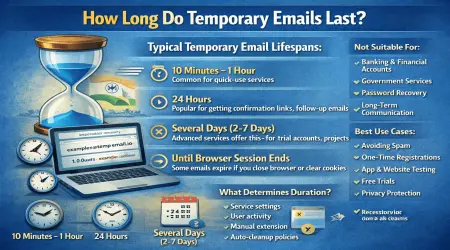
One major issue is account recovery. Most apps rely on email for password resets. If your temporary email expires or becomes inaccessible, you could lose access to your account permanently. That might not matter for a casual game, but it becomes a serious problem for apps storing important data.
Some apps also use email for:
- Two-factor authentication
- Transaction receipts
- Subscription management
- Device verification
- Security alerts
If you lose access to that email, you lose a critical recovery channel.
There’s also another practical limitation: app ecosystems.
Many mobile apps today are connected to services that expect consistent user identities. If your email disappears, your account history might become harder to manage or recover across devices.
So while temporary emails may work technically, they are often unreliable for apps where long-term access matters.
How Apps Detect Temporary Emails
You might wonder how apps even know whether an email is temporary.
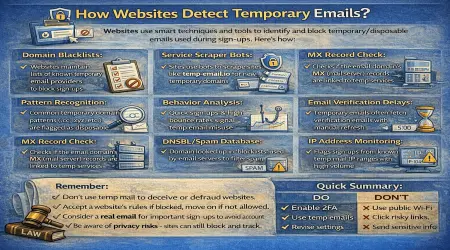
It turns out many services maintain lists of known disposable email domains. When you enter your email during signup, the app checks it against these databases.
If your email matches a known temporary provider, the system may:
- Block the registration
- Ask for a different email
- Limit account features
- Flag the account for review
Some apps go further by analyzing signup behavior, device information, and usage patterns to detect suspicious or non-genuine accounts.
This is not necessarily about privacy—it’s about preventing spam, abuse, or fake account creation.
From the company’s perspective, disposable emails can sometimes be associated with bots, fake users, or repeated signups that distort analytics or abuse free trials.
So even if a temporary email works at first, it may not always be accepted across different apps.
The Privacy Trade-Off You Should Understand
At first glance, temporary emails seem like a perfect privacy solution. And in some situations, they are useful.
But there is a trade-off that many users overlook.
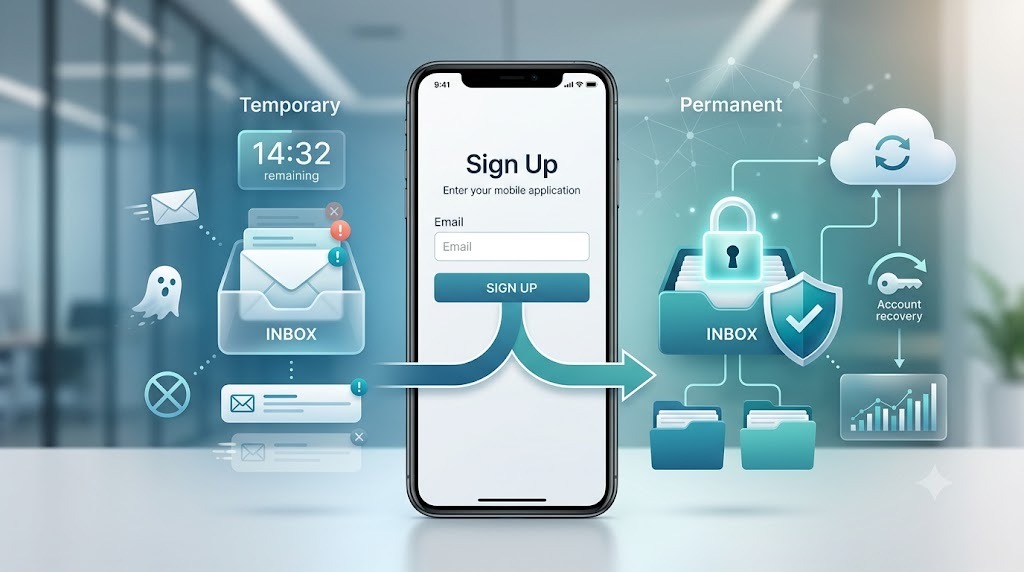
When you use a temporary email for a mobile app, you are trading long-term control for short-term convenience.
That means:
- You gain privacy from spam and marketing emails
- You reduce exposure of your real inbox
- You avoid linking your primary identity
- But you also lose reliable account recovery
- And you risk losing access to the account entirely
This trade-off is fine for low-risk apps. But it becomes risky when the app holds important data.
Think about a budgeting app, a fitness tracker with years of progress, or a subscription service you pay for monthly. In those cases, losing access because your email expired would be frustrating and potentially costly.
So the key question is not just “Does it work?” but also “What happens if it stops working?”
A Smarter Way to Use Emails for Mobile Apps
Instead of thinking in extremes—either always using your real email or always using temporary ones—a better approach is balance.
A practical strategy many privacy-conscious users follow is email segmentation.
This means using different types of emails for different levels of importance.
For example:
You might use your primary email for important apps like banking, health, or subscriptions.
You might use a secondary email for general apps that you use regularly but don’t consider critical.
And you might use temporary emails for apps you are only testing or don’t plan to revisit.
This layered approach gives you flexibility without sacrificing security or control.
It also helps keep your main inbox cleaner and reduces exposure over time.
Final Thoughts
So, do temporary emails work for mobile app signups?
Yes, they often do—but not always, and not equally well across all apps.
They are useful for testing, experimenting, and protecting your inbox from unnecessary clutter. But they are not reliable for apps where long-term access, account recovery, or sensitive data is involved.
The real decision comes down to understanding what the app means to you. If it’s disposable, your email can be too. If it matters long-term, your email should be stable.
Temporary emails are a tool, not a universal solution. When used wisely, they can improve your privacy and reduce spam. But when used carelessly, they can create more problems than they solve.
The best approach is always intentionality—choosing the right type of email for the right situation, instead of defaulting to one method for everything.
Have you ever tried using a temporary email for an app signup? Share your experience in the comments and let others know what worked—or didn’t work—for you.