How Long Does a Temporary Email Last
A few years ago, the idea of using a temporary email sounded unusual to most internet users. Email addresses were something you created once and kept for years. They became part of your identity, connected to your work, social media accounts, shopping platforms, and almost every online service you used.
Today, things look a little different.
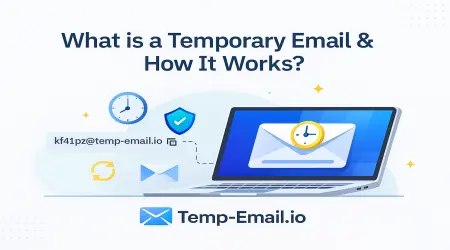
As more websites require registration for even the simplest actions, people have started looking for ways to protect their inboxes from spam, unwanted marketing messages, and unnecessary data collection. This is one reason temporary email services have become increasingly popular. Whether someone wants to download a free resource, test a new platform, or sign up for a one-time service, a temporary email can provide a quick and convenient solution.
One of the most common questions people ask, however, is surprisingly simple: How long does a temporary email last?
The answer depends on the service being used, but the question reveals something interesting about how temporary emails work. Unlike traditional email accounts, they are designed with a different purpose in mind. Their lifespan is intentionally limited, and understanding that limitation can help users make smarter decisions about when and how to use them.
Let's explore how temporary emails work, how long they typically remain active, and why their temporary nature is actually their biggest advantage.
Understanding the Purpose of Temporary Emails
Before discussing how long a temporary email lasts, it helps to understand why these services exist in the first place.
Think about how many times you've been asked for an email address online. A website wants you to create an account before reading an article. A software tool requires registration before offering a free trial. An online store asks for your email to access a discount code.
In many situations, you may only need access for a few minutes. You don't necessarily want an ongoing relationship with the website, and you certainly don't want your personal inbox filling up with promotional messages for months afterward.
This is where temporary email services become useful.
Instead of using your primary email address, you can generate a disposable inbox that exists solely for receiving verification messages or temporary communications. Once you've completed your task, the email address can be discarded without affecting your personal inbox.
The goal isn't to replace your main email account. Rather, it's to create a layer of separation between your permanent digital identity and short-term online interactions.
So, How Long Does a Temporary Email Actually Last?
The lifespan of a temporary email varies depending on the provider.
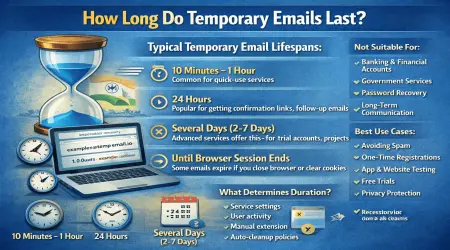
Some temporary email services keep inboxes active for only ten or fifteen minutes. Others may allow access for several hours. Certain providers maintain inboxes for a day or longer, while some offer the option to extend the lifespan manually.
In general, most temporary email services are designed to exist only long enough for users to receive a verification code, activation link, or confirmation message. Once that purpose has been fulfilled, the email address and its contents are eventually removed from the system.
This automatic deletion is not a flaw. In fact, it's one of the primary features.
The temporary nature of these email addresses helps reduce data retention and minimizes the amount of information stored over long periods. Because the address is not intended to become a permanent part of your online identity, there's little reason for it to remain active indefinitely.
Think of it like a visitor pass at a building. You use it to gain access for a short period, complete your task, and then return it when you're finished. Temporary emails operate on a similar principle in the digital world.
Why Temporary Emails Expire
At first glance, expiration might seem inconvenient. After all, wouldn't it be easier if the address remained available forever?
The reality is that expiration is what makes temporary emails effective.
A permanent email address accumulates information over time. It receives newsletters, advertisements, account notifications, promotional offers, and countless other messages. Eventually, the inbox becomes crowded and difficult to manage.
Temporary email services take the opposite approach. They are designed to be lightweight, short-lived, and focused on a single purpose.
By automatically removing inactive inboxes, providers can maintain system efficiency while helping users avoid long-term clutter. More importantly, expiration limits the amount of historical information associated with a particular address.
In a world where data is constantly being collected and stored, having information automatically disappear can actually be a privacy benefit.
What Happens After a Temporary Email Expires?
Many first-time users wonder what happens when the lifespan of a temporary email ends.
In most cases, the inbox and its messages are deleted from the service. Depending on the provider, the email address itself may become unavailable or eventually return to a pool of reusable addresses.
This means that users should never rely on temporary emails for important long-term communications. If you need ongoing access to an account, password recovery options, or future notifications, a temporary email is usually not the best choice.
For example, using a temporary email for online banking, work-related services, healthcare platforms, or critical business accounts would create unnecessary risks. If you lose access to the temporary inbox later, recovering the account may become difficult or impossible.
Temporary emails work best when the interaction itself is temporary.
That's an important distinction that many users overlook.
When a Temporary Email Makes Sense
The usefulness of temporary emails becomes clear when you look at common online situations.
Imagine you're testing a software tool you've never used before. The website requires registration, but you're not sure whether you'll continue using the service. Instead of sharing your primary email address immediately, a temporary email allows you to evaluate the platform first.
The same applies to one-time downloads, trial subscriptions, webinar registrations, online forums, and various promotional offers.
In these situations, the temporary nature of the email aligns perfectly with the temporary nature of the interaction.
You're essentially saying, "I need access right now, but I don't necessarily need a permanent relationship."
That flexibility is one reason temporary email services continue growing in popularity among privacy-conscious internet users.
Common Misunderstandings About Temporary Emails
One misconception is that temporary emails provide complete anonymity.
They don't.
While temporary emails help reduce exposure of your primary inbox, they are only one part of a broader privacy strategy. Websites may still collect other information such as device details, browser data, IP addresses, and user behavior patterns.
Another misunderstanding is that all temporary emails expire at the same rate. In reality, every provider operates differently. Some prioritize speed and short lifespans, while others offer more flexibility.
Users should always review how a specific service works before relying on it for any important task.
The key takeaway is that temporary emails are tools designed for convenience and privacy—not permanent identity management.
The Future of Temporary Emails
As the internet continues requiring more registrations, subscriptions, and account verifications, temporary emails are becoming increasingly relevant.
Many users are growing more aware of how often their personal information is requested online. They're beginning to question whether every website truly needs permanent access to their inbox.
At the same time, concerns about spam, data breaches, and digital footprints continue to grow. Temporary emails provide a practical response to these challenges by allowing users to separate casual online interactions from their primary digital identity.
In the future, this separation may become even more common.
Rather than using one email address for everything, people are increasingly adopting a layered approach to digital identity. Permanent emails for important accounts. Secondary emails for subscriptions. Temporary emails for one-time interactions.
This approach gives users greater control over how and where their information is shared.
Conclusion
So, how long does a temporary email last?
The simple answer is that it depends on the service, but most temporary emails remain active anywhere from a few minutes to several hours or days before being automatically removed.
More importantly, their limited lifespan is what makes them useful. Temporary emails are designed for short-term tasks, quick verifications, and situations where sharing your primary email address may not be necessary. They help reduce inbox clutter, minimize unwanted marketing messages, and provide an extra layer of separation between your identity and casual online activities.
They are not meant to replace your permanent email account, nor should they be used for critical services that require long-term access. Instead, they work best when used exactly as intended: as a temporary solution for temporary needs.
As online registrations continue to increase, understanding when to use a temporary email—and how long it lasts—can help you navigate the internet more efficiently while keeping your primary inbox cleaner and more manageable.
Have you ever used a temporary email for a one-time sign-up or free trial? Share your experience and let us know how it helped simplify your online life.