How Temporary Emails Fit Into the Future of Online Anonymity
When anonymity stopped feeling simple
There was a time when being “anonymous online” sounded easy.
You could browse a website, read articles, watch videos, and leave without telling anyone who you were. No accounts, no sign-ups, no digital fingerprints following you around. At least, that’s how it felt.
But the internet today works very differently.
Even before you create an account, websites already gather small pieces of information about your device, your location region, and your behavior. It’s not always dramatic or visible. In fact, most of the time it happens quietly in the background while you’re just trying to access something simple.
And that’s exactly where temporary emails started becoming more relevant—not as a “tech trick,” but as a response to how the internet itself has changed.
Because anonymity today is no longer about disappearing completely. It’s more about controlling how much of yourself you expose and where you choose to leave traces behind.
Why your real email became the center of your digital identity
To understand why temporary emails matter in the future of anonymity, it helps to understand one simple truth: your email address has quietly become one of the most stable identifiers you have online.
It connects your accounts, resets your passwords, confirms your identity, and ties together your activity across different platforms. Over time, it becomes less of a communication tool and more of a digital anchor.
The moment you start using your primary email everywhere, something interesting happens. Your online identity stops being scattered and starts becoming centralized. Websites don’t just see isolated visits anymore. They start seeing patterns connected to a single identity.
This is not necessarily a bad thing. In many cases, it improves convenience. You don’t have to remember dozens of usernames. You can recover accounts easily. Everything feels connected.
But from a privacy perspective, this also means one thing very clearly: your email becomes the bridge between your actions and your identity.
And that’s where temporary emails enter the picture.
Temporary emails as a “separation layer” for identity
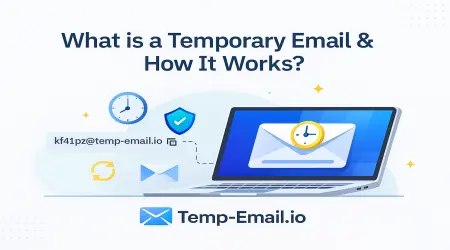
A temporary email is simple in concept. It’s an address you use for a short time, usually for quick sign-ups or one-time interactions, and then discard.
But its real importance is not technical—it’s structural.
Think of it as creating a separation layer between you and the internet service you’re interacting with. Instead of giving your permanent identity to every website you visit, you create a buffer. A version of yourself that exists only for that specific interaction.
This changes the way data flows.
Instead of one stable identity being reused everywhere, you begin to distribute your presence across multiple temporary points. Some disappear quickly. Some never connect back to your real inbox. And some exist only for a few minutes.
This doesn’t make you invisible, but it does make you less traceable in a direct, linear way.
And in the future of online anonymity, that difference matters more than people realize.
The internet is moving toward identity overload, not identity loss
There’s a common assumption that the future of privacy will be about complete anonymity. But in reality, the direction of the internet is more complex.
We are not moving toward less identity online. We are moving toward more identities.
One person today can have multiple layers of digital existence. A professional identity, a shopping identity, a social identity, and sometimes even a completely anonymous browsing identity.
This fragmentation is not accidental. It is a natural response to how much data modern systems collect and how deeply they analyze behavior.
Temporary emails fit into this shift in a very practical way. They allow users to create lightweight identities that don’t become part of their permanent digital history. Instead of adding everything into one long-term profile, users can isolate specific interactions.
For example, someone might use a temporary email for the following:
A one-time download from a website they don’t fully trust
A short-term tool or free trial
A forum or community they don’t plan to return to
A service that only requires single verification
In each case, the goal is not secrecy. The goal is containment.
Why anonymity today is about reducing traceability, not erasing identity
A lot of people misunderstand online anonymity. They imagine it as becoming completely untraceable, as if disappearing from systems entirely.
But modern anonymity doesn’t work like that.
Most systems today don’t rely on just email addresses to understand users. They use device signals, browser behavior, IP patterns, and interaction data. Even without an account, users can often be grouped into behavioral categories.
So temporary emails don’t create full anonymity on their own. Instead, they reduce one of the strongest linking points between your actions and your identity: persistent account-based tracking.
When you use your real email everywhere, you create a consistent thread that connects your activity across platforms. When you use temporary emails selectively, you break that thread in certain places.
It’s not about hiding everything. It’s about preventing unnecessary connection points from forming.
A small example that makes it easier to understand
Imagine two people browsing the internet.
One person uses their primary email for every sign-up, every download, every trial, and every website they interact with. Over time, their email becomes attached to hundreds of services.
The other person is more selective. They use their primary email only for important accounts—banking, work, essential communication. For everything else, they use temporary emails.
Years later, both users exist in multiple databases, both have been part of data systems, and both have left digital traces.
But there’s a difference.
The first person’s online identity is heavily centralized. A lot of their activity can be linked through one stable identifier.
The second person’s activity is more fragmented. Some interactions are tied to permanent identity; others exist in disconnected temporary spaces that don’t contribute to long-term profiling.
Neither approach makes someone invisible. But one creates far more continuity than the other.
And continuity is what modern data systems rely on most.
The future: anonymity as a controlled experience, not a default state
Looking ahead, online anonymity is unlikely to become a simple on/off switch. Instead, it will become something users manage consciously depending on context.
Temporary emails are part of that shift. They represent a broader trend toward controlled exposure—deciding what deserves long-term identity and what doesn’t.
As data collection becomes more advanced, users are also becoming more aware. People are starting to question why every interaction requires permanent identity. They are becoming more selective about what they register for and more cautious about how often they reuse personal identifiers.
In that environment, temporary emails are not just a convenience tool. They become part of a broader privacy mindset.
Not “how do I hide completely,” but rather “how do I control what becomes part of my permanent digital self.”
Final thoughts
Temporary emails don’t create full anonymity, and they were never meant to.
Instead, they offer something more realistic for today’s internet: flexibility.
They allow users to participate in online services without automatically attaching every action to a permanent identity. They create space between curiosity and commitment. And they reduce unnecessary connections in a world where almost every interaction leaves a trace.
As the internet continues to evolve, anonymity is becoming less about disappearing and more about choosing. Choosing when to reveal identity, when to stay temporary, and when to stay fully connected.
Temporary emails fit into that future not as a replacement for privacy but as one of its simplest building blocks.
And in a digital world where every action leaves a footprint, even small tools like this can change how much of your identity stays permanently attached to the internet.
If you think about it, the real question isn’t whether anonymity will exist in the future. It’s how carefully we’ll decide when to use it.
And temporary emails are already part of that decision.