Temporary Email vs Personal Email
Temporary Email vs Personal Email: When to Use Each
Have you ever signed up for a website and immediately started receiving dozens of promotional emails you never asked for? Or maybe you've hesitated before entering your personal email address because you weren't sure whether a website could be trusted.
Most of us have experienced both situations.
Email has become one of the most important parts of our digital lives. We use it for banking, online shopping, social media accounts, job applications, work communication, newsletters, and countless other activities. Yet many people still use the same email address for everything, from important financial accounts to random websites they visit once and never return to.
That's where the conversation about temporary email vs personal email becomes important.
A temporary email address can help protect your privacy and reduce unwanted messages, while a personal email address serves as your long-term digital identity. Both have valuable roles, but knowing when to use each one can save you from inbox clutter, privacy concerns, and even security risks.
The challenge is that many beginners don't fully understand the difference. Some people use temporary emails too often and end up losing access to accounts. Others use their personal email everywhere and later wonder why their inbox feels impossible to manage.
In this guide, we'll break everything down in simple language. We'll explore what temporary and personal emails are, their advantages and disadvantages, practical examples of when to use each, and how to make smarter decisions online. By the end, you'll have a much clearer idea of which option makes sense in different situations.
Understanding Temporary Email and Personal Email
Before comparing them, it's helpful to understand what each one actually does.
A personal email address is the email account you create for long-term use. It might be something you've had for years. You use it to communicate with friends, family members, coworkers, clients, schools, and businesses. It becomes part of your online identity.
Think of your personal email like your home address. It's where important information arrives and where people can reliably reach you.
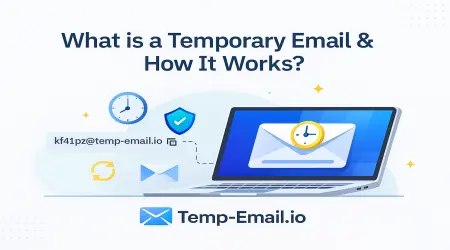
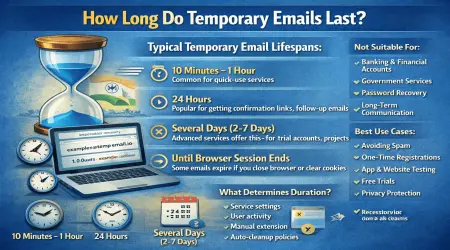
A temporary email, often called a disposable email, works differently. It's designed for short-term use. Instead of creating a permanent account, you receive an email address that may only exist for a few minutes, hours, or days.
Imagine receiving a flyer on the street. You want to look at it once but don't want the company to contact you forever. A temporary email serves a similar purpose online.
For example, suppose you're curious about an ebook that requires email registration. You're not sure whether the website is trustworthy or if it will flood your inbox with marketing messages. Rather than providing your primary email address, you can use a temporary email.
This simple distinction creates very different use cases.
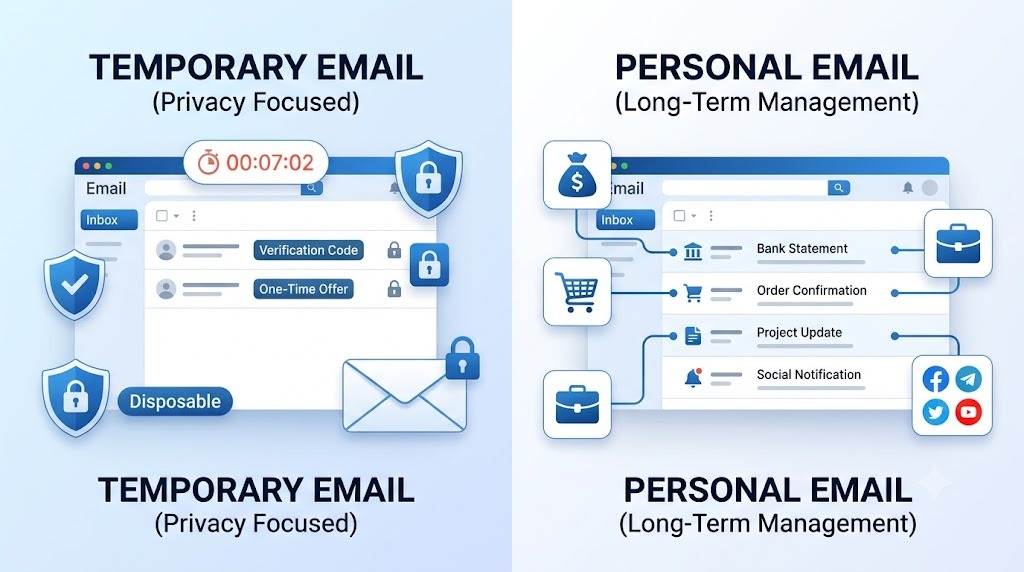
Your personal email is built for ongoing relationships and important communication. Temporary email is built for convenience, privacy, and short-term interactions.
Neither is inherently better than the other. The real question is understanding when each option makes the most sense.
The Advantages and Limitations of Temporary Email
Temporary email services have become increasingly popular as internet users become more aware of privacy concerns.
One of the biggest benefits is protection from spam.
Let's say you want to download a free PDF guide. The website asks for your email address. You suspect they're mainly interested in adding you to a marketing list. Instead of exposing your personal inbox, you can use a temporary email address and receive the download link without future promotional messages.
This can dramatically reduce inbox clutter over time.
Another major advantage is privacy. Every time you share your email address online, you're providing a piece of personal information. Many websites collect email addresses for advertising, analytics, or customer profiling. Temporary emails create a buffer between you and those systems.
They're also useful for testing services.
Developers, marketers, students, and everyday users often need to create trial accounts. Maybe you're exploring a software tool and only want to see how it works. A temporary email allows quick registration without committing your real contact information.
However, temporary email isn't perfect.
One significant limitation is account recovery. If you lose access to an account created with a temporary email, recovering that account may be impossible.
Imagine signing up for a website using a disposable email. A few months later, you decide you actually want to use the service regularly. Unfortunately, you forgot your password. Since the temporary email no longer exists, password recovery becomes difficult or impossible.
Another issue is trust.
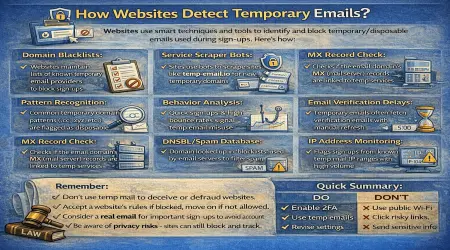
Many websites actively block disposable email services because they want legitimate users. Some platforms detect temporary email domains and refuse registration altogether.
There is also the issue of continuity. Temporary emails are designed for short-term interactions. They aren't suitable when you expect future communication, updates, invoices, receipts, or account notifications.
In short, temporary email is excellent for one-time interactions but often problematic for long-term relationships.
Why Personal Email Still Matters
Despite the growing popularity of temporary email services, personal email remains essential.
Your personal email acts as your digital headquarters.
Think about all the services connected to your email address:
- Online banking
- Shopping accounts
- Social media profiles
- Streaming subscriptions
- Educational platforms
- Government services
- Professional communication
These relationships require stability.
When a bank sends a security alert, you need to receive it. When an employer contacts you regarding a job application, missing that email could have serious consequences. When an online store sends a shipping update, you'll want access to it.
A personal email address provides that consistency.
Another important benefit is credibility.
Imagine applying for a job using a temporary email address. It might appear unprofessional or suspicious. Employers generally expect candidates to use a stable, professional email account.
The same principle applies to business communication.
If you're a freelancer, consultant, entrepreneur, or professional, your email address becomes part of your personal brand. A reliable email helps establish trust and demonstrates professionalism.
Personal email also supports long-term organization.
Many people underestimate how valuable old emails can become. Purchase receipts, warranty information, travel confirmations, legal documents, educational records, and financial statements often need to be stored for years.
A temporary email cannot provide that level of record keeping.
Of course, personal email comes with challenges too.
The biggest problem is spam accumulation.
Over time, promotional emails, newsletters, marketing campaigns, and automated notifications can overwhelm an inbox. This often happens because users share their primary email address too freely.
That's exactly why understanding the balance between temporary and personal email is so important.
When You Should Use a Temporary Email
The easiest way to understand temporary email is through real-life scenarios.
Suppose you're reading an article and a pop-up offers a free downloadable checklist. The website requires email registration, but you don't intend to interact with the site again. A temporary email is often a practical choice.
Similarly, imagine you're comparing online tools. You want to test three different services before deciding which one to keep. Using temporary emails for initial exploration can prevent unnecessary promotional messages from filling your inbox.
Temporary email works well in situations like:
- Downloading one-time resources
- Accessing free trials
- Testing websites or apps
- Registering for short-term services
- Joining temporary discussions or forums
- Verifying curiosity-driven signups
I often compare temporary email to using a guest parking space. You're only staying briefly, so you don't need a permanent parking permit.
However, before using a temporary email, ask yourself a simple question:
"Will I need access to this account six months from now?"
If the answer is yes, a temporary email may not be the best option.
Many people make the mistake of treating disposable emails as permanent solutions. Then they discover they can't access important account information later.
A little foresight can prevent a lot of frustration.
The key is viewing temporary email as a convenience tool rather than a long-term identity.
When You Should Always Use a Personal Email
There are certain situations where using your personal email isn't just recommended—it's essential.
Financial services are a perfect example.
Bank accounts, payment platforms, investment services, insurance portals, and tax-related accounts should always be connected to a reliable email address that you control permanently.
The same applies to shopping accounts.
Many online retailers store order histories, invoices, warranties, and return information. Losing access to those records can become inconvenient very quickly.
Career-related activities also require a personal email.
Whether you're applying for jobs, networking with professionals, communicating with clients, or managing freelance projects, consistency matters.
Educational accounts deserve similar treatment.
Schools, universities, online courses, and certification platforms frequently send updates, deadlines, grades, and important announcements. Missing those communications could create unnecessary problems.
Social media accounts are another category where personal email is generally the safer option.
These accounts often serve as recovery channels for other services. Losing access to them can create a chain reaction of account recovery challenges.
Here's a useful rule of thumb:
If the account contains money, personal information, professional opportunities, long-term records, or anything you truly value, use your personal email.
In these situations, stability is more important than avoiding a few promotional messages.
A reliable email address provides peace of mind that's difficult to replace.
Finding the Right Balance Between Privacy and Convenience
The smartest internet users don't choose between temporary email and personal email.
They use both strategically.
Think of it as organizing your home.
You probably have a safe place for important documents and another place for junk mail. You wouldn't mix tax records with advertising flyers. The same logic applies to email.
Many people maintain multiple email strategies.
For example, they may use:
- One primary email for important accounts
- One secondary email for newsletters and promotions
- Temporary emails for one-time signups
This approach creates a cleaner, more organized digital life.
A friend of mine adopted this system after becoming overwhelmed by thousands of unread messages. His primary inbox became reserved for important communication, while promotional content went elsewhere. Within a few weeks, finding important emails became dramatically easier.
Privacy awareness also plays an important role.
Not every website deserves the same level of trust. Before providing your personal email, consider:
- Is the website reputable?
- Will you need future access?
- Does the service seem trustworthy?
- Is there a clear privacy policy?
- Are you likely to use the service again?
These simple questions can help determine which email type is most appropriate.
The internet isn't becoming less connected. If anything, more services require email registration every year. Learning how to manage your email exposure is becoming an increasingly valuable digital skill.
Rather than viewing temporary email and personal email as competitors, think of them as tools designed for different jobs.
A hammer isn't better than a screwdriver. It simply serves a different purpose.
The same principle applies here.
Conclusion
The debate around temporary email vs. personal email isn't about choosing one over the other. It's about understanding the strengths and weaknesses of each option.
Temporary email shines when you need privacy, want to avoid spam, or only plan to interact with a website once. It's a practical solution for downloads, trials, testing, and short-term registrations.
Personal email, on the other hand, remains essential for important accounts, financial services, professional communication, shopping platforms, education, and any situation where long-term access matters.
The most effective approach is often a balanced one. Use your personal email for relationships and services you value, and reserve temporary email for situations where convenience and privacy are the priority.
As our digital lives continue to expand, making smarter choices about where and how we share our email addresses can save time, reduce inbox clutter, and improve online security.
What about you? Do you use temporary email services, or do you rely entirely on your personal email? Share your thoughts and experiences in the comments, and if you found this guide helpful, consider sharing it with friends who could benefit from a cleaner, more organized inbox.