What Are the Risks of Using Disposable Email Addresses?
Risks of Using Disposable Email
Disposable email addresses have become a common tool for internet users who want to protect their privacy, avoid spam, and keep their primary inbox clean. With countless websites asking for email verification before granting access to content, free trials, downloads, or online communities, it's easy to see why temporary email services have gained popularity.
At first glance, disposable emails seem like the perfect solution. They provide instant access without requiring users to share their personal email address. They reduce unwanted marketing messages and create a convenient barrier between your real identity and websites you may never visit again.
Because of these benefits, many people assume that disposable emails are always the safer choice. However, like most privacy tools, they come with advantages and limitations. While they can be incredibly useful in the right situations, they also introduce risks that many users overlook until it's too late.
The truth is that disposable email addresses are neither good nor bad on their own. Their effectiveness depends entirely on how they're used. Understanding their risks can help users make smarter decisions and avoid common mistakes that could lead to lost accounts, missed communications, or unexpected security problems.
Why Disposable Emails Have Become So Popular
To understand the risks, it helps to first understand why disposable emails exist.
The modern internet runs on registrations. Want to download a PDF? Enter your email. Interested in testing a new software platform? Create an account. Looking for a discount code? Provide an email address first.
Over time, these requests add up. Many users discover that their inboxes are filled with promotional emails from services they barely remember signing up for. Some messages arrive daily, others weekly, and many continue for years.
Disposable email services offer an alternative. Instead of exposing a personal email address to every website, users can generate a temporary inbox for one-time interactions. Once the purpose has been fulfilled, the inbox can be discarded.
This approach reduces clutter and adds a layer of privacy. But convenience often comes with trade-offs, and disposable emails are no exception.
The Biggest Risk: Losing Access to Important Accounts
Perhaps the most common problem associated with disposable email addresses is losing access to accounts.
Many people create an account on a website using a temporary email because they believe they'll only use the service once. Then something unexpected happens. The service turns out to be useful. Weeks later, they return and decide they want to continue using it.
Unfortunately, by that point, the disposable inbox may no longer exist.
Without access to the original email address, recovering passwords, verifying account ownership, or receiving security notifications can become difficult. In some cases, users permanently lose access to their accounts because they can no longer receive verification emails.
This risk is particularly significant for platforms that store valuable information, personal projects, or subscription data. A decision made for convenience today can become a frustrating problem months later.
That's why disposable emails should generally be reserved for genuinely temporary interactions rather than services you may want to use long-term.
Missing Important Communications
Another overlooked risk involves communication itself.
When people think about email, they often focus on spam and marketing messages. However, emails also serve important purposes. Companies send security alerts, account updates, billing notifications, and policy changes through email.
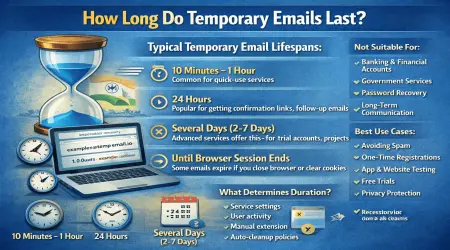
If you're using a disposable address, those messages may never reach you once the inbox expires.
Imagine signing up for a service using a temporary email and later discovering there was suspicious activity on your account. The platform sends a warning, but you never receive it because the email address is no longer active.
The same issue can occur with subscription renewals, account verification requests, or service interruptions. While these situations may not happen often, they highlight why disposable emails are unsuitable for accounts that require ongoing communication.
Not Every Disposable Email Service Offers the Same Privacy
Many users assume that all temporary email providers offer identical levels of privacy and security. In reality, there can be significant differences between services.
Some providers prioritize user privacy and minimize data retention. Others may operate under different policies. Because disposable email platforms vary widely, users should understand how a particular service handles messages, storage, and user information before relying on it.
This doesn't mean temporary email services are inherently unsafe. It simply means users should avoid assuming that every provider follows the same standards.
A privacy tool is only as trustworthy as the platform behind it.
Public Inbox Visibility Can Create Problems
One risk that surprises many first-time users is the fact that some disposable email systems use publicly accessible inboxes.
Depending on how a service is designed, certain temporary email addresses may not be intended for private communication. If another user can access the same inbox or view incoming messages, sensitive information could potentially be exposed.
This is one reason disposable emails should never be used for financial accounts, healthcare services, confidential business communication, or anything involving sensitive personal information.
Temporary emails are excellent for low-risk registrations and one-time verifications. They are not designed to replace secure personal email accounts.
Understanding this distinction is essential for using them responsibly.
WebsitesCanblockDisposableEmails
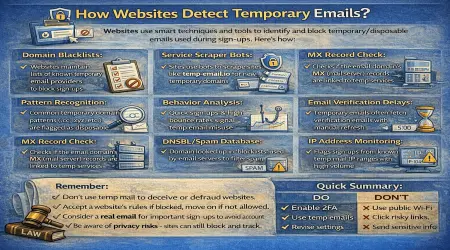
Another practical risk is that many websites actively block disposable email addresses.
Businesses often do this to reduce abuse, prevent fake registrations, and improve the quality of their user base. As a result, users may encounter registration forms that reject temporary email domains entirely.
This can be frustrating when you're attempting to access a legitimate service. In some cases, you'll have no choice but to provide a permanent email address if you want to create an account.
The growing popularity of disposable email services has led many companies to become more sophisticated in detecting and filtering them. While this doesn't eliminate their usefulness, it does limit where they can be used successfully.
The False Sense of Complete Anonymity
One of the most important risks is psychological rather than technical.
Some users mistakenly believe that a disposable email makes them completely anonymous online. This misunderstanding can lead to risky behavior and unrealistic expectations.
While temporary emails help protect your primary inbox and reduce direct exposure of your personal email address, they do not make you invisible. Websites can still collect information about devices, browsers, IP addresses, user behavior, and other digital signals.
A disposable email is a privacy tool, not an invisibility cloak.
The distinction matters because effective online privacy comes from understanding the capabilities and limitations of the tools you use. Temporary emails can reduce certain forms of exposure, but they are only one part of a broader privacy strategy.
When Disposable Emails Are a Smart Choice
Despite these risks, disposable emails remain valuable tools when used appropriately.
They are particularly useful for one-time downloads, temporary registrations, software testing, promotional offers, and situations where future communication is unlikely to matter.
In these cases, the benefits often outweigh the drawbacks. Users can protect their primary inbox, reduce spam, and limit unnecessary sharing of personal information without sacrificing convenience.
The key is matching the tool to the situation.
If the interaction is temporary, a disposable email often makes sense. If the relationship is likely to become long-term, a permanent email address is usually the safer choice.
Conclusion
So, what are the risks of using disposable email addresses?
The biggest risks include losing access to accounts, missing important communications, relying on services with unclear privacy practices, and developing unrealistic expectations about anonymity. Additionally, some websites block disposable emails entirely, limiting their usefulness in certain situations.
None of these risks mean disposable emails should be avoided. In fact, they remain one of the simplest and most practical tools for reducing inbox clutter and protecting personal email addresses during short-term online interactions.
The important thing is understanding what they are designed to do—and what they are not designed to do.
Disposable emails work best when used for temporary situations. They are excellent for quick sign-ups, free trials, and one-time verifications. However, they should not replace permanent email accounts for services that require ongoing communication, account recovery, or long-term access.
Like any privacy tool, their value comes from using them wisely. When you understand both the benefits and the risks, disposable email addresses can become a useful part of a smarter and more intentional online experience.
Have you ever used a disposable email and later regretted it—or found it incredibly useful? Share your experience and join the discussion.